
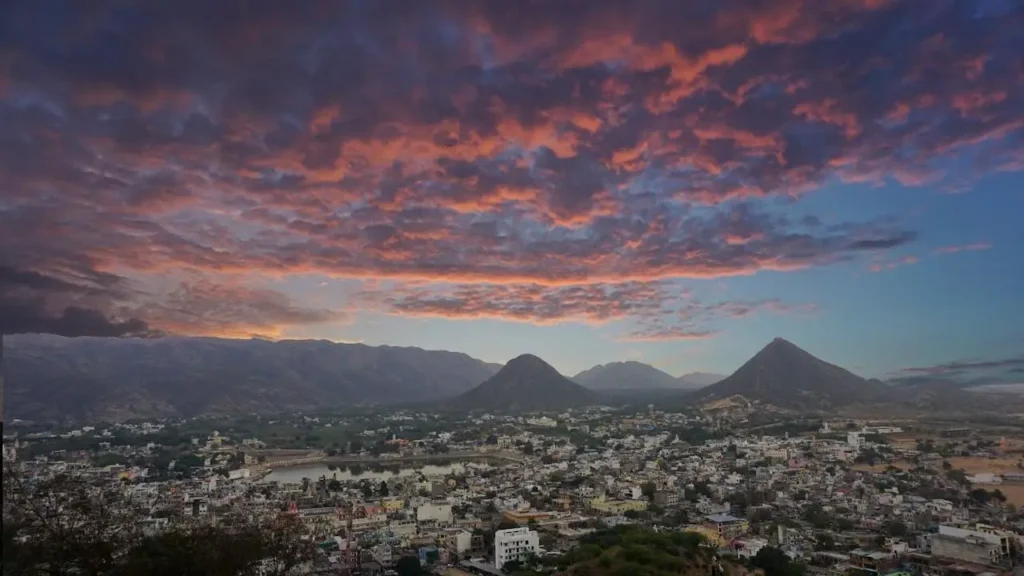
There are places where time feels steady rather than fast. Life continues as it does everywhere, but moments are not pushed forward. Attention settles naturally, and days unfold through light, movement, and shared spaces instead of urgency. Pushkar, a small town in Rajasthan, India, holds this quality quietly. Set beside the desert and centred around a sacred lake, the town feels grounded and consistent, shaped by routine, belief, and long-standing habits.
Pushkar moves at an even pace. Its streets curve gently and rise and fall without sharp turns. Homes, temples, and small shops sit close together, their walls marked by sun and age. The colours remain soft and practical, faded pinks, pale yellows, and light blues that shift slightly with the daylight. It is common to see people walking slowly, stopping often, or sitting along the streets. Even during busier hours, the town rarely feels rushed.
The lake forms the centre of daily life. Activity naturally gathers along its edge. Many people walk around it at an unhurried pace, stopping to sit on the steps or to look into the water. Fish move just below the surface, visible and calm, and it is common to see people feeding them wheat balls and watching quietly as they gather. These moments happen throughout the day without ceremony, part of the regular rhythm of the place.
The ghats around the lake maintain a clear sense of order. Shoes are removed before stepping onto the stone, a practice followed carefully and without reminder. This simple act changes how people move and speak. Steps slow, voices soften, and attention shifts inward. Bells ring from nearby temples, and incense drifts through the air. The space feels cared for through shared respect rather than instruction.
As the day continues, the lake becomes both a place to pause and a place to gather. Cafés sit close to the water, offering seating that faces the lake rather than turning away from it. People sit for long stretches, talking quietly or simply watching the water. Conversations pause often, especially as the light changes. The cafés blend into the surroundings, adding to the scene without distracting from it.
Toward evening, the lake draws more attention. The light lowers, reflections deepen, and many people stop along the ghats to watch the sunset. The fish remain active, the water catching small movements and fading colour. There is little noise. Most people observe quietly, staying until the light fades.
Beyond the lake, daily life continues in familiar patterns. Streets fill and empty gradually. Shopkeepers sit at doorways, and movement through the narrow lanes tends to be gradual rather than hurried. The desert landscape sits just beyond the town, and its presence can be felt in the open sky and steady air. Daily activity follows a measured rhythm, with quieter moments appearing naturally between periods of use.
This balance defines Pushkar. The sacred and the everyday exist side by side, visible not only around the lake but across the wider landscape of the town. Religious spaces are part of regular movement rather than isolated destinations. Jagatpita Shri Brahma Mandir remains central to Pushkar’s identity, receiving a steady presence throughout the year and grounding long-standing rituals within daily life. Shree Savitri Mata Mandir sits above the town, overlooking the lake and the surrounding land. People reach it either by ropeway or by walking upward along the path, gradually taking in wider views of the town below, patches of greenery, and the open landscape beyond. Together, these lower streets and higher viewpoints offer a fuller sense of Pushkar, allowing the town to be experienced both closely and from a wider perspective.
Once a year, this rhythm expands during the Pushkar Camel Fair. The town welcomes a large gathering of people and animals, and the surrounding land fills with movement. Camels arrive slowly from distant areas, decorated simply, moving in long lines. The fair brings noise, colour, and crowds, yet the town’s underlying pace remains visible. People spend time watching, talking, and waiting. The fair feels like an addition rather than a disruption.

The fair is a significant moment, but it exists within the town’s ongoing pattern. It arrives, fills the surrounding land with activity, and then recedes, leaving behind the same lake, the same ghats, and the same steady routines that shape the town throughout the year. Pushkar does not reorganize itself around the event. Instead, the event passes through a place that is already complete in its own rhythm.
In the days that follow, attention returns naturally to the lake. Movement slows again along its edge, cafés face the water as they always do, and the stone steps continue to receive visitors who come to sit, watch, or remain quiet. The town resumes its familiar balance, not as a contrast to the fair, but as its foundation.
As night approaches, lights appear gradually and reflections stretch across the lake. Sounds soften, and activity thins rather than stops. The day ends without emphasis or announcement. Pushkar continues as it does every evening, shaped by repetition rather than interruption.
Stillness is not the absence of movement, but the absence of urgency.
That thought rests easily within the town, reflected in the way life continues without needing to assert itself.